


I painted these in the studio. The beadwork came later, in Cape Town, from other hands.
Much of art is made alone. Some of the most powerful work is not. Michelangelo did not lay the plaster on the Sistine ceiling or grind the pigments that fused into it. Greek vases carry two signatures, the potter and the painter. Rauschenberg worked beside craftspeople in Chile, China, and Cuba. Sol LeWitt drew the plans and let others draw the walls. Judy Chicago handed “The Dinner Party” to hundreds of women. William Kentridge sends his charcoal drawings from Johannesburg to weavers in the Eastern Cape. Some of my favorite work is a collaboration between the artist and the artisan. All art is a collaboration between the artist and the observer.
Monkeybiz is a collective of Xhosa women who work from their homes in the townships around Cape Town. They bead in a tradition that runs back centuries in South Africa. Beadwork there is a language. Colors carry meaning. Patterns record kinship, courtship, mourning, initiation. Before glass beads came in on European trade ships, their grandmothers were working shell and ostrich eggshell into similar shapes. The vocabulary belongs to them.
I chose the colors from the paintings. They chose the process, and brought to it a technique inherited across generations. Then they began.
Some of them spent three weeks on a single piece, working at kitchen tables, placing bead after bead across the surface of the paintings. Thandi Mankosi beaded “Watchers.” Noluvo Nojekwa and Babalwa Manxilana beaded “Sunrise.” Each finished work carries the hand of a specific woman with a specific life and a specific inheritance. That is what I cherish most. Every piece is one of one. Every piece has a story that is no longer only mine.
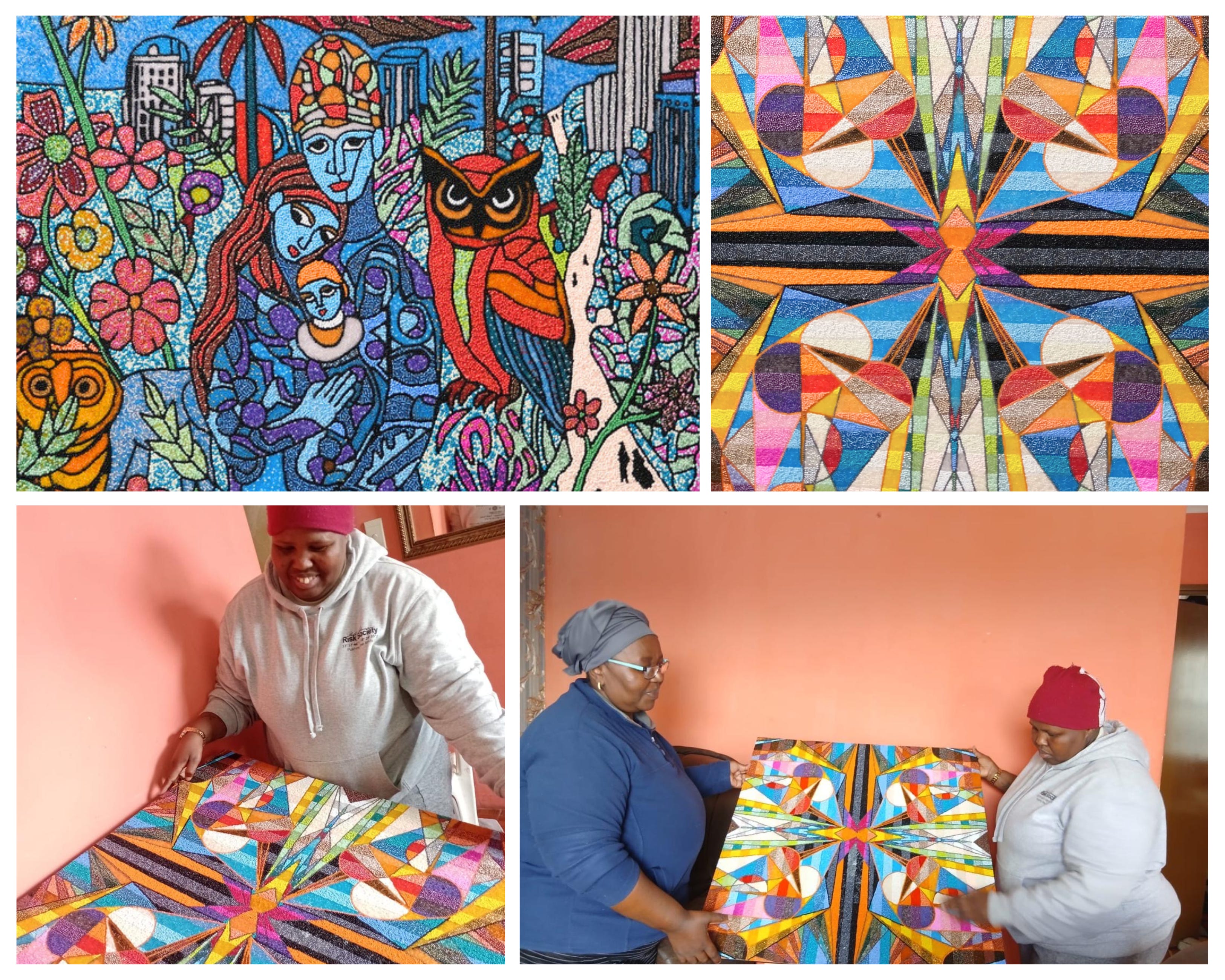
The painting becomes a sculpture in beads laid by hand one at a time, bead by bead. All the hands visible in every piece. The beadwork answered something in the paint I had not seen until they showed it to me.